
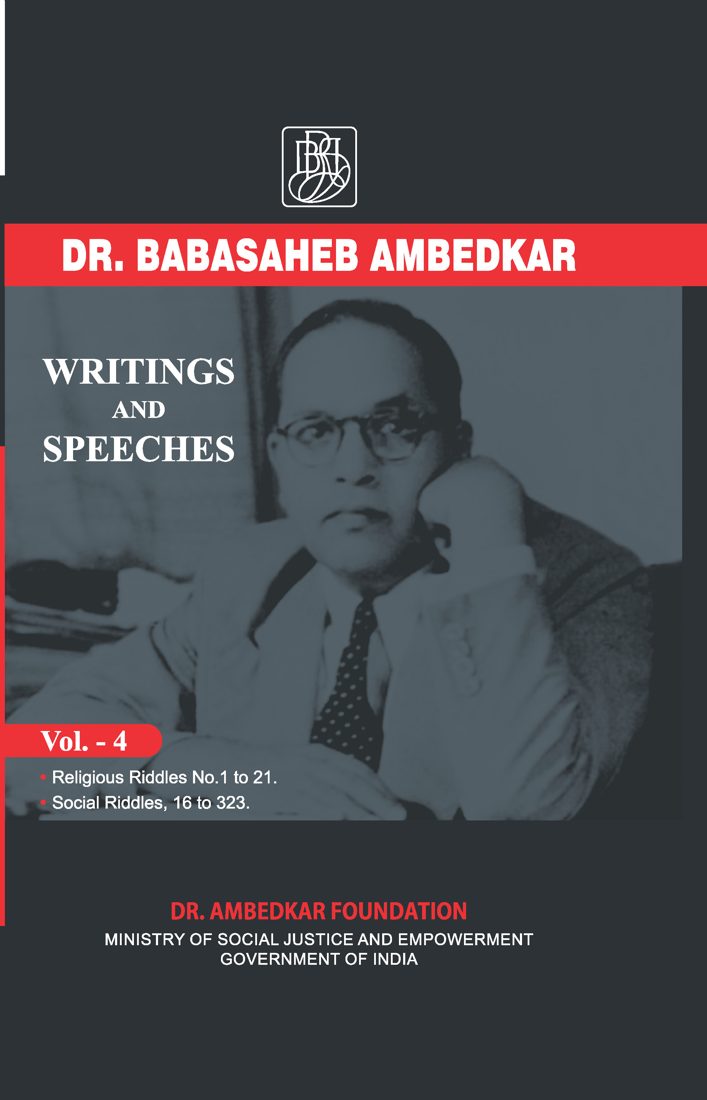
Dr. Babasaheb Ambedkar: Writings and Speeches
Vol. 4
Riddles in Hinduism
33 chapters · 378 pages
Contents
- Front matterpp. 1–15
- 1. Introductionpp. 16–23
- Part I — Religious2. Riddle No. 1 The Difficulty of Knowing why one is a Hindupp. 24–26
- 3. Riddle No. 2 The Origin of the Vedas—The Brahminic Explanation or an exercise in the art of circumlocutionpp. 27–29
- 4. Riddle No. 3 The Testimony of other Shastras on the origin of the Vedaspp. 30–35
- 5. Riddle No. 4 Why suddenly the Brahmins declare the Vedas to be infallible and not to be questioned?pp. 36–38
- 6. Riddle No. 5 Why did the Brahmins go further and declare that the Vedas are neither made by man nor by God ?pp. 39–47
- moral or spiritual value?pp. 48–63
- 8. Riddle No. 7 The turn of the tide Or How did the Brahmins declare the Vedas to be lower than the lowest of their Shastras?pp. 64–72
- 9. Riddle No. 8 How the Upanishads declared War on the Vedas ?pp. 73–77
- 10. Riddle No. 9 How the Upanishads came to be made subordinate to the Vedas?pp. 78–81
- 11. Riddle No. 10 Why did the Brahmins make the Hindu Gods fight against one another?pp. 82–90
- 12. Riddle No. 11 Why did the Brahmins make the Hindu Gods suffer to rise and fall?pp. 91–109
- 13. Riddle No. 12 Why did the Brahmins dethrone the Gods and enthrone the Goddesses?pp. 110–118
- 14. Riddle No. 13 The Riddle of the Ahimsapp. 119–123
- 15. Riddle No. 14 From Ahimsa back to Himsapp. 124–127
- 16. Riddle No. 15 How did the Brahmins Wed an Ahimsak God to a Bloodthirsty Goddess?pp. 128–138
- 17. Appendix I The Riddle of the Vedaspp. 139–161
- 18. Appendix II The Riddle of the Vedantapp. 162–171
- 19. Appendix III The Riddle of the Trimurtipp. 172–186
- 20. Appendix IV Smarth Dharma and Tantrik Dharmapp. 187–193
- 21. Appendix V The Infallibility of the Vedaspp. 194–199
- Part II — Social22. Riddle No. 16 The Four Varnas—Are the Brahmins sure of their origin?pp. 200–215
- 23. Riddle No. 17 The Four Ashramas—The Why and How about thempp. 216–225
- 24. Riddle No. 18 Manu’s madness or the Brahmanic explanation of the origin of the mixed castespp. 226–236
- 25. Riddle No. 19 The change from Paternity to Maternity. What did the Brahmins wish to gain by it?pp. 237–243
- 26. Riddle No. 20 Kali Varjya or the Brahmanic art of suspending the operation of Sin without calling it Sinpp. 244–246
- 27. Appendix I The Riddle of the Varnashram Dharmapp. 247–272
- 28. Appendix II Compulsory Matrimonypp. 273–285
- Part III — Political29. Riddle No. 21 The Theory of Manvantarapp. 286–291
- 30. Riddle No 22 Brahma is not Dharma. What good is Brahma?pp. 292–298
- 31. Riddle No 23 Kali yuga—Why have the Brahmins made it unending?pp. 299–317
- 32. Riddle No 24 The Riddle of the Kali yugapp. 318–333
- 33. Appendix I The Riddle of Rama and Krishnapp. 334–378