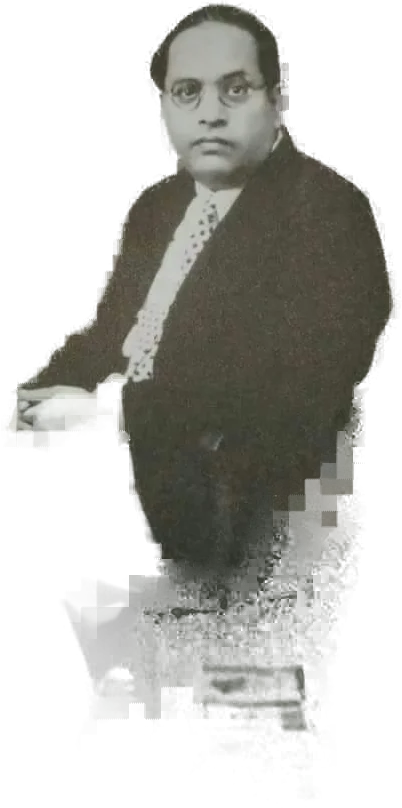
1891 – 1956 · A life in paper

Bhimrao Ramji Ambedkar

From a soldier's son made to sit apart on a gunny sack, to the man who drafted India's Constitution and led millions to the Buddha. 13 chapters, 195 moments, told in paper, photographs and sound.

Scroll to turn the pages · photographs are originals; where none exist he is drawn in paper

Ambedkar and his followers at the Vijaystambha (victory pillar) at Bhima Koregaon near Pune on 1 January 1927. According to the Commons description, Shivram Janba Kamble, who organised the meeting, stands to his left wearing a garland.
At the Bhima Koregaon pillar, 1 January 1927
A portrait identified on Wikimedia Commons as Subhedar Ramji Maloji Sakpal (1838–1913), Bhimrao's father, who served as a Subedar-Major in the army. Undated; the original photographer and source are unknown.
Ramji Maloji Sakpal, Ambedkar's father
Chapter 1 · Before 1891

Before Bhimrao

1 / 10

Battle of Koregaon near Pune, fought largely by a Bombay Native Infantry battalion in which many Mahars served

source ↗

At the Bhima Koregaon pillar, 1 January 1927: Photo: Unknown photographer (1927); uploaded to Commons by Sandesh Hiwale (संदेश हिवाळे) · CC BY-SA 4.0 · Ramji Maloji Sakpal, Ambedkar's father: Photo: Unknown author · Public domain (PD-India)

An old photograph captioned "Shewing our quarters at Mhow and the different bungalows", taken some time between about 1890 and 1910. Mhow was the army town where Bhimrao was born in 1891.
Army quarters at Mhow, around 1900
A portrait identified on Wikimedia Commons as Subhedar Ramji Maloji Sakpal (1838–1913), Bhimrao's father, who served as a Subedar-Major in the army. Undated; the original photographer and source are unknown.
Ramji Maloji Sakpal, Ambedkar's father
Chapter 2 · 1891–1904

Childhood

1 / 8

Bhimrao is born at Mhow, an army cantonment near Indore

source ↗

Army quarters at Mhow, around 1900: Photo: Unknown author · Public domain (PD-Art, PD-old) · Ramji Maloji Sakpal, Ambedkar's father: Photo: Unknown author · Public domain (PD-India)

Elphinstone College, Bombay, in a photograph from 1904, published in D. A. Pinder's Visitor's Illustrated Guide to Bombay.
Elphinstone College, 1904
Krishnaji Arjun (Dada) Keluskar, a Marathi writer and social reformer. According to the Commons description, he presented young Bhimrao with his own biography of the Buddha at a felicitation held when Bhimrao passed his matriculation examination in 1907. Undated photograph.
Krishnaji Arjun Keluskar
A map of Bombay from about 1903, published in John Murray's A Handbook for Travellers in India, Burma and Ceylon.
Map of Bombay, 1903
Chapter 3 · 1904–1913

School and College Years

1 / 10

The family moves from Satara to Bombay; Bhimrao joins Elphinstone High School

source ↗

Elphinstone College, 1904: Photo: Unknown photographer (from D. A. Pinder, Visitor's Illustrated Guide to Bombay, 1904) · Public domain (PD-old) · Krishnaji Arjun Keluskar: Photo: Unknown author · Public domain (PD-India) · Map of Bombay, 1903: Photo: John Murray (publisher), A Handbook for Travellers in India, Burma and Ceylon · Public domain (PD-old-70-expired)

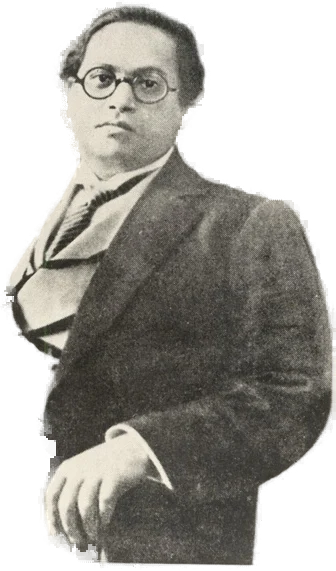
A portrait of Ambedkar described on Wikimedia Commons as taken during his time at Columbia University (1913–1916). The photographer is unknown.
Ambedkar at Columbia University
Dr. Ambedkar (photograph cut out)
Chapter 4 · 1913–1916

Columbia University

1 / 13

Baroda scholarship of £11.50 a month for three years begins (dates as given by The Beacon)

source ↗

Ambedkar at Columbia University: Photo: Unknown author · Public domain (PD-India)

Ambedkar (first from right in the second row) with his professors and friends from the London School of Economics and Political Science, 1916–17.
With professors and friends at the London School of Economics
Dr. Ambedkar (photograph cut out)
Chapter 5 · 1916–1923

London, Baroda and London Again

1 / 17

Registers at LSE for the MSc (Econ)

source ↗

With professors and friends at the London School of Economics: Photo: Unknown author · Public domain (PD-India)
The reception committee for the Mahad Satyagraha with Ambedkar, R. B. More and other social workers, dated 20 March 1927 on Wikimedia Commons.
Reception committee for the Mahad Satyagraha, 1927
Ambedkar and his followers at the Vijaystambha (victory pillar) at Bhima Koregaon near Pune on 1 January 1927. According to the Commons description, Shivram Janba Kamble, who organised the meeting, stands to his left wearing a garland.
At the Bhima Koregaon pillar, 1 January 1927
A photograph of the satyagraha led by Ambedkar at the Kalaram Temple in Nashik to demand entry for untouchable people, dated 2 March 1930 on Wikimedia Commons.
Kalaram Temple Satyagraha, Nashik, 1930
Front page of the first issue of Bahishkrit Bharat ('Excluded India'), the Marathi fortnightly Ambedkar launched in Bombay on 3 April 1927, with its chained-lions masthead. Cropped from a Commons image showing Mooknayak and Bahishkrit Bharat side by side; low resolution.
Bahishkrit Bharat, 3 April 1927
Chapter 6 · 1919–1929

Awakening

1 / 16

Gives evidence to the Southborough (Franchise) Committee

source ↗

Reception committee for the Mahad Satyagraha, 1927: Photo: Unknown (from the uploader's family archive) · CC BY-SA 4.0 · At the Bhima Koregaon pillar, 1 January 1927: Photo: Unknown photographer (1927); uploaded to Commons by Sandesh Hiwale (संदेश हिवाळे) · CC BY-SA 4.0 · Kalaram Temple Satyagraha, Nashik, 1930: Photo: Unknown author · Public domain (PD-India) · Bahishkrit Bharat, 3 April 1927: Photo: Bahishkrit Bharat (ed. B. R. Ambedkar) · Public domain (PD-India)

A view of the Round Table Conference in London in 1931; the Commons description says that both Gandhi and Ambedkar are present.
Second Round Table Conference, London, 1931
Ambedkar with M. R. Jayakar and Tej Bahadur Sapru at Yerwada, Pune. The Commons description dates it 24 September 1932, the day Ambedkar signed the Poona Pact.
At Yerwada at the time of the Poona Pact, 1932
The Second Round Table Conference in London, October 1931, with British Prime Minister Ramsay MacDonald to the right of Gandhi. Ambedkar, representing the depressed classes, is fourth from left in the foreground.
Second Round Table Conference, October 1931
Chapter 7 · 1930–1935

The Round Table

1 / 16

Kalaram Temple satyagraha conference at Nashik; protest at the gates begins next day

source ↗

Second Round Table Conference, London, 1931: Photo: Unknown author · Public domain (PD-1996, PD-UK-unknown) · At Yerwada at the time of the Poona Pact, 1932: Photo: Unknown author · Public domain (PD-India) · Second Round Table Conference, October 1931: Photo: Unknown author · Public domain (PD-1996, PD-UK-unknown)

Ambedkar speaking at Yeola, Nashik district, on 13 October 1935, the conference where he declared he would not die a Hindu.
Speech at Yeola, 13 October 1935
Ambedkar with women delegates at the All India Depressed Classes Women's Conference in Nagpur, July 1942. According to the Commons description, more than 25,000 women took part.
Women's conference at Nagpur, 1942
Muhammad Ali Jinnah, Periyar E. V. Ramasamy and Ambedkar at Jinnah's residence in Bombay on 6 January 1940.
Jinnah, Periyar and Ambedkar, 1940
Dr. Ambedkar (photograph cut out)
Chapter 8 · 1936–1946

Party, Parliament and the Labour Ministry

1 / 25

Publishes Annihilation of Caste after the Lahore conference is cancelled

source ↗

Speech at Yeola, 13 October 1935: Photo: Unknown author · Public domain (PD-India) · Women's conference at Nagpur, 1942: Photo: Unknown author · Public domain (PD-India) · Jinnah, Periyar and Ambedkar, 1940: Photo: Unknown author · Public domain (PD-India)

Ambedkar, Chairman of the Drafting Committee, presenting the final draft of the Constitution to Rajendra Prasad, President of the Constituent Assembly, on 25 November 1949.
Presenting the final draft of the Constitution, 1949
The Drafting Committee of the Constitution, 29 August 1947. Seated from left: N. Madhava Rao, Syed Muhammad Saadulla, B. R. Ambedkar (Chairman), Alladi Krishnaswamy Iyer and Sir B. N. Rau. Standing from left: S. N. Mukherjee, Jugal Kishore Khanna and Kewal Krishnan.
The Drafting Committee, 1947
Members at the Constituent Assembly of India in December 1946. In the first row from left: B. R. Ambedkar, B. G. Kher, Vallabhbhai Patel and K. M. Munshi. (Commons describes it as the first day and dates it 11 December 1946; the Assembly first met on 9 December.)
First day of the Constituent Assembly, 1946
Dr. Ambedkar (photograph cut out)
Chapter 9 · 1946–1950

Making the Constitution

1 / 20

Constituent Assembly meets for the first time; Dr. Ambedkar signs the register as a member from Bengal

source ↗

Presenting the final draft of the Constitution, 1949: Photo: Unknown author · Public domain (PD-India) · The Drafting Committee, 1947: Photo: Unknown author · Public domain (PD-India) · First day of the Constituent Assembly, 1946: Photo: Unknown author · Public domain (PD-India)
Ambedkar, Jawaharlal Nehru, Maulana Azad and other ministers at a lunch given by Vallabhbhai Patel in June 1948 to mark C. Rajagopalachari becoming the first Indian Governor-General.
With Nehru's cabinet, June 1948
Ambedkar opening a conference on the Hindu Code Bill in New Delhi, dated 21 April 1950 on Wikimedia Commons.
Conference on the Hindu Code Bill, 1950
Dr. Ambedkar (photograph cut out)
Chapter 10 · 1947–1956

Law Minister and Opposition Voice

1 / 17

Hindu Code Bill is introduced in the central legislature

source ↗

With Nehru's cabinet, June 1948: Photo: Unknown author · Public domain (PD-India) · Conference on the Hindu Code Bill, 1950: Photo: Unknown author · Public domain (PD-India)
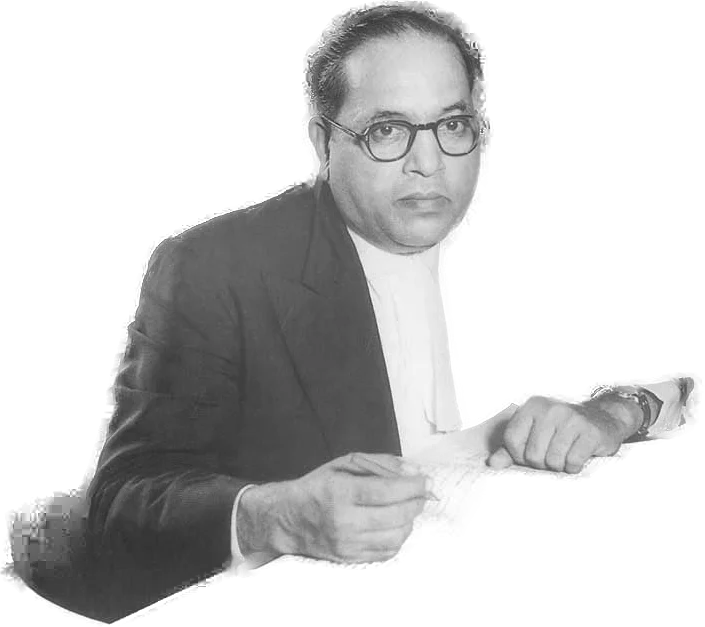
Ambedkar giving his 22 vows to his followers at Deekshabhoomi, Nagpur, on 14 October 1956.
Giving the 22 vows at Deekshabhoomi, 1956
Ambedkar with Savita Ambedkar, who holds a statue of the Buddha, at the conversion ceremony in Nagpur on 14 October 1956.
With Savita Ambedkar holding a Buddha statue, 1956
The huge gathering at Nagpur as Ambedkar gave Dhamma Deeksha to his followers in October 1956. The Commons description says about half a million people took part.
The great crowd at Nagpur, 1956
Dr. Ambedkar (photograph cut out)
Chapter 11 · 1935–1956

The Road to Buddhism

1 / 13

Krishnaji Arjun Keluskar gives young Bhimrao his Marathi book on the life of the Buddha

source ↗

Giving the 22 vows at Deekshabhoomi, 1956: Photo: Unknown author · Public domain (PD-India) · With Savita Ambedkar holding a Buddha statue, 1956: Photo: Unknown author · Public domain (PD-India) · The great crowd at Nagpur, 1956: Photo: Unknown author · Public domain (PD-India)
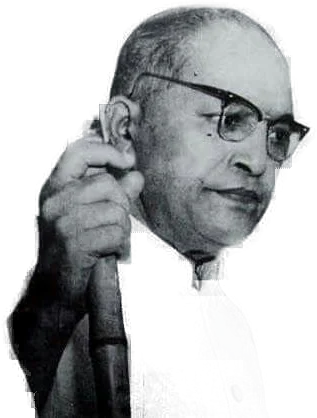
Ambedkar delivering his speech on the Buddha and Karl Marx to the fourth World Buddhist Conference in Kathmandu, Nepal, on 20 November 1956. King Mahendra of Nepal, Savita Ambedkar and Bhante Chandramani are also seen.
"The Buddha and Karl Marx" speech, Kathmandu, 1956
Widely shared online as Dr. Ambedkar with the Dalai Lama at Ashoka Buddha Vihar, Delhi, and dated 2 December 1956 on Wikimedia Commons. Neither the identification nor the date has a documented source, so treat both as unconfirmed.
Shared as "with the Dalai Lama", Delhi
A vast crowd accompanying Ambedkar's body towards Chaitya Bhoomi in Bombay on 7 December 1956.
Funeral procession in Bombay, 1956
Chapter 12 · November–December 1956

The Final Days

1 / 10

Flies from Patna to Kathmandu for the Fourth World Fellowship of Buddhists conference

source ↗

"The Buddha and Karl Marx" speech, Kathmandu, 1956: Photo: Unknown author · Public domain (PD-India) · Shared as "with the Dalai Lama", Delhi: Photo: Unknown author · Public domain (PD-India) · Funeral procession in Bombay, 1956: Photo: Unknown author · Public domain (PD-India)

The foundation stone of Milind College, Aurangabad, was laid by President Rajendra Prasad on 1 September 1950, with Ambedkar present.
Foundation of Milind College, 1950
Ambedkar with the American poet Wallace Stevens at Columbia University, New York, on 5 June 1952, when Columbia awarded Ambedkar an honorary Doctor of Laws.
At Columbia University with Wallace Stevens, 1952
Dr. Ambedkar (photograph cut out)
Chapter 13 · 1956–today

Legacy

1 / 20

The Scheduled Castes Federation is turned into the Republican Party of India, as he had planned

source ↗

Foundation of Milind College, 1950: Photo: Unknown author · Public domain (PD-India) · At Columbia University with Wallace Stevens, 1952: Photo: Unknown author · Public domain (PD-India)
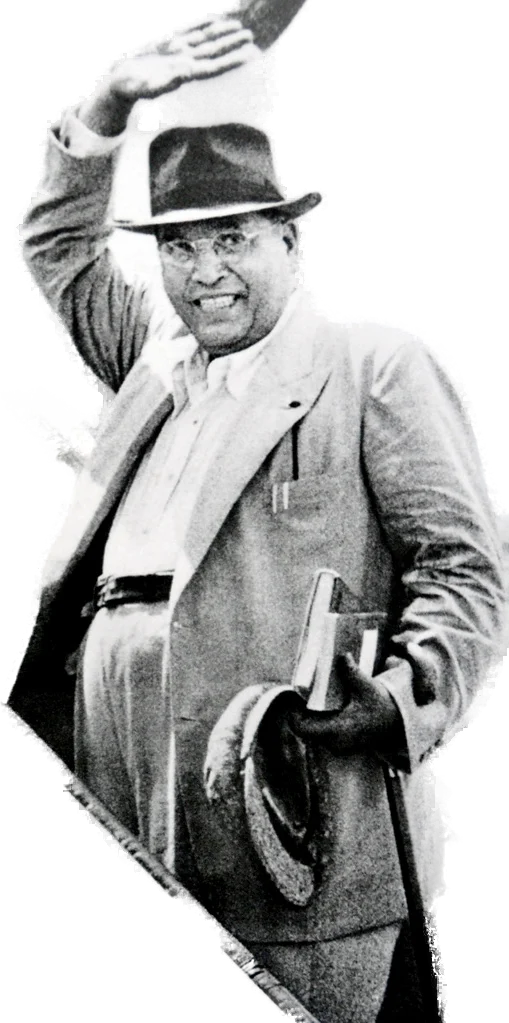
6 December 1956 – today

Educate · Agitate · Organise

His words are all here, word for word. Read them, and tell his story onward.